
Railway Review
Worth it when a stopped service should leave the bill, and a weak default when the process stays running with no cap.
Railway is worth it in 2026 when you want the invoice to follow CPU and memory the service actually holds, and a stopped process to cost nothing. Hobby is $5 a month and that fee is the usage credit, while Pro is $20 per workspace with seats included, verified on Railway's pricing page on September 24, 2026.
A service left running still bills with zero requests, because sleep is a setting you have to turn on. Compare Render when you want a sized instance you can read before you deploy, and Fly.io when the region is why you are choosing a host. Choose Heroku when you want a named dyno instead of a usage meter.
Railway fits a backend that sits quiet most of the day, and it is a poor fit when staging is left running. The subscription is a floor on the invoice rather than a ceiling, so a quiet month still costs the plan.
Toolradar data: the hosting and deployment ranking we publish scored 297 products in September 2026. The median cheapest paid plan among the 10 at the top is $5.50/mo, and Railway is outside that ten. The decision is whether a stopped service leaves the invoice.
How we compared: Railway, Render, Fly.io, Northflank, DigitalOcean App Platform, and Heroku, in USD, on September 24, 2026. Nobody paid for a slot. We did not deploy a test app. A frontend with no long-running process belongs on the Vercel review.
What is Railway?
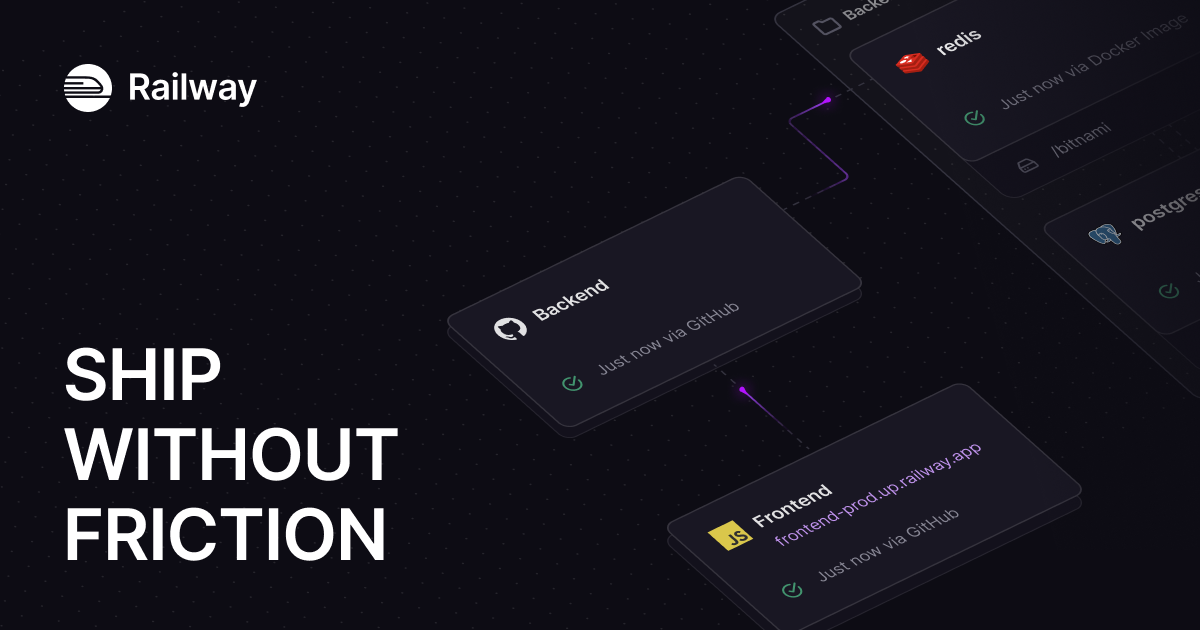
Railway is a usage-billed platform for services you deploy from GitHub, a Docker image, the CLI, or a template. Nixpacks can build the image, or you bring a Dockerfile, and build CPU, memory, and image storage are not charged, so a rebuild does not add a line.
The canvas is services rather than dyno types, so Postgres, Redis, MongoDB, and ClickHouse templates are a service plus a volume and the disk line follows that volume. A public URL and a private URL both exist, and only the private one is free to talk to, so the public database hostname is the one that adds a network charge.
Enterprise is a contract, while Hobby and Pro are the self-serve bills you can open without a sales conversation.
How Railway works
You connect a repo and Railway runs a service, and CPU, memory, and disk bill per second while it runs. A stopped service costs nothing, while an idle process that stays up still bills RAM and CPU.
Serverless is the off switch, and it stays off until you enable it, so a quiet app does not sleep on its own. The docs call a service inactive about 5 minutes after the last outbound packet, and sampling means sleep usually lands between 5 and 10 minutes. The toggle hits every replica and starts on the next deploy.
A database pool, Next.js telemetry, NTP, and private-network calls all count as outbound, so any of them keeps the meter running. The metrics graph hides private traffic, so a service can look idle and still stay awake, and the first request after sleep can return a 502. A webhook that does not retry will drop that event.
Five open pull requests can burn the credit five times over, because each preview is another running copy. The private hostname is not egress, and the public database URL is, so database calls belong on the private hostname.
Railway key features
Railway pricing
Read the credit before the resource rates, because the Hobby fee and the Pro fee are minimums that wipe the first slice of CPU, memory, disk, and egress. Unused credit dies at the end of the cycle, and a quiet month still costs the subscription, which the plans FAQ states outright, so low usage does not zero the bill.
The pricing page meters resources per second and prints a monthly constant beside each rate, for comparison only. One full gigabyte of RAM for the whole month is the memory row, and that single line spends half the Pro credit before any vCPU time.
A second replica doubles that draw, CPU is its own row, and a full vCPU for the month equals one Pro fee by itself.
Free is a $1 monthly credit, one project, three services, one member, and no custom domain, so it cannot carry a production hostname. The per-service cap is 1 vCPU and the memory on the Free row.
Trial is a one-time credit equal to one Hobby month, with no card, then it expires, and upgrading carries any leftover trial balance onto the paid plan.
Hobby is the solo plan: 50 projects, 50 services, 3 members per project, 2 custom domains, and the volume ceiling in the table. Pro is the team plan: one fee per workspace, a zero seat line, unlimited members, and 20 custom domains.
Logs run 3 days on Free, 7 on Hobby, and 30 on Pro, so a longer history means a higher plan. Rollback of a removed deploy lasts 24 hours on Free, 72 on Hobby, and 120 on Pro.
After you cancel, volume data is deleted in 30 days on Free, 60 on Hobby, and 90 on Pro, so a cancelled volume is not a backup. Invoices under $0.50 are carried forward, and a partial charge can hit mid-cycle. A post-paid card is required, a Hobby fee waiver exists and is automatic, and Railway will not review requests.
SSO and RBAC are tied to committed spend or Enterprise, not to the Pro fee, so the self-serve plan does not include SSO. Business Class Support has no published price, and Enterprise publishes no list price, so neither can be budgeted from the plan fee.
The other hosts in the table sell a size or a region, not a credit. Render's paid instances do not spin down, Fly.io has no workspace fee, and Northflank's sandbox stays awake. App Platform's smallest shared container matches the Hobby sticker, and Heroku's metrics dyno does not add RAM.
Prices below were read on each vendor's pricing page on September 24, 2026.
| Plan | Price | Best for |
|---|---|---|
| Railway Free | $0, plus $1/mo credit | 1 project, 3 services, 0 custom domains, 0.5 GB cap per service. |
| Railway Trial | $0 for 30 days | One-time credit equal to one Hobby month. No card. Balance can carry over. |
| Railway Hobby | $5/mo | Matching credit. 2 custom domains, 5 GB volume cap, 3 members. |
| Railway Pro | $20/workspace/mo | Credit matches the fee. Unlimited seats. 20 custom domains. 30-day logs. |
| Railway CPU | $0.00000772/vCPU/s | A full month of one vCPU equals the Pro fee. Stopped services drop it. |
| Railway memory | $10 per GB | Per second while running. One always-on GB spends half the Pro credit. |
| Railway volume | $0.15 per GB | Hobby ceiling is 5 GB. Pro can self-serve to 1 TB. |
| Railway service egress | $0.05 per GB | Public database URLs count. Private networking inside the project does not. |
| Railway object storage | $0.015 per GB-month | Egress from object storage is waived. Service egress is not. |
| Railway sandbox VM | $50/vCPU and $50/GB | While running. Waiting still holds memory. Draws on the same credit. |
| Render Starter | $7/mo | 512 MB, 0.5 CPU. Paid instances do not spin down. |
| Render Pro workspace | $25/mo | Unlimited seats, 25 GB bandwidth, then the per-GB rate below. |
| Render bandwidth overage | $0.15 per GB | Hobby includes 5 GB. Free web services count against that pool. |
| Render Postgres Basic-256mb | $6/mo | 256 MB, 100 connections, 1 GB storage. Free Postgres expires in 30 days. |
| Fly.io shared-cpu-1x | $1.94 to $3.14/mo | 256 MB. The spread is the region tables on the pricing page. |
| Fly.io support Standard | $29/mo | Separate from the Machine. A card is required on the organization. |
| Northflank nf-compute-10 | $2.70/mo | 0.1 shared vCPU, 256 MB, prorated to the second. Egress is $0.06/GB. |
| App Platform shared 512 MiB | Matches the Hobby fee | 1 vCPU, 50 GiB transfer. Extra outbound is $0.02/GiB. |
| App Platform dev database | $7 for 512 MiB | No default backups. Destroyed with the app. Postgres only. |
| Heroku Basic | $7/dyno/mo | Always on, 0.5 GB. Eco is personal-only and sleeps after 30 minutes. |
| Heroku Standard-1X | $25/dyno/mo | Metrics and preboot. RAM stays 0.5 GB. |
Railway pros and cons
What we like
- The paid subscription is the usage credit, so a month under that credit adds no second line.
- A stopped service drops CPU and memory, and Serverless can sleep a quiet app in about 5 to 10 minutes.
- Pro is one workspace fee with a zero seat line, so a teammate does not add a seat charge.
What could be better
- Sleep is off by default, so an idle service that is still running keeps billing RAM and CPU.
- Free stops at one project and the memory cap on the Free row, so a production app has to leave it.
Who Railway is for
Railway fits a developer who will turn Serverless on, set a compute cap, and keep databases on the private hostname. Hobby covers a side project under the credit, and Pro is the switch when the volume ceiling or a teammate needs the workspace.
Skip it when the app must stay warm, because a running service bills with no users. Skip it when Postgres should be a named plan: see Postgres hosting, the Neon review, and Supabase if auth ships with the database.
A page-only Next.js app is a closer call on the Vercel review and the serverless platforms roundup. Next.js telemetry is outbound traffic, and it blocks Railway sleep.
For a sized instance, start with the Heroku alternatives and the Heroku review. For a VM you administer, use VPS hosting for developers and the DigitalOcean review.
A box you patch yourself is the self-hosting tools list, a cluster you already operate is the Kubernetes tools decision, and subscribe free for the next credit note.
Best Railway alternatives
If Railway is not the right fit, these are the closest options.
| Tool | Best for | Starts at | |
|---|---|---|---|
| Railway | Backends that should pay for CPU and RAM in use, and drop compute when stopped. | Hobby $5/mo includes the usage credit | Visit → |
| Render | Teams that want a sized web instance and a Postgres plan with a sticker. | Starter is 512 MB and 0 | Visit → |
| Fly.io | Long-running Machines in a chosen region, billed while the Machine stays started. | shared-cpu-1x at 256 MB lists from $1 | Visit → |
| Northflank | Containers and previews for teams that need a sandbox that stays awake. | From $2 | Visit → |
| DigitalOcean App Platform | Git deploys when the rest of the stack is already on DigitalOcean. | Smallest shared container matches Hobby | Visit → |
| Heroku | Teams that want a named dyno and a Postgres add-on on one invoice. | Basic is the always-on dyno in the table | Visit → |
The bottom line
Pay for Railway when the workload can sleep, someone will set a hard limit, and services talk on the private hostname. Start on Trial with no card, move to Hobby before a production hostname, and move to Pro when the volume or the replica ceiling is the blocker.
Leave it when the process must stay warm, because a running service spends the memory row with no users and a full vCPU spends a Pro fee of compute on its own. That ceiling is a sized instance on Render, or a dyno on Heroku.
Choose Fly.io when the region table matters and a workspace fee does not, Northflank when the sandbox should stay awake, and App Platform when the account already pays DigitalOcean.
Subscribe free if you want the next credit change in the Devshot brief.
Cite this: Devshot, "Railway Review 2026", September 2026.
Frequently asked questions
Get the Devshot brief
Free daily newsletter, read in 5 minutes.
Subscribe free