
Better Stack Review
Uptime monitoring, on-call and a logs, traces and metrics backend sold by the bundle, with a free plan for personal projects. What it costs a real team, where it beats Datadog and where it does not.

Better Stack is worth it for small engineering teams that want uptime checks, on-call paging and a log backend from one vendor at a price they can predict. The free plan covers 10 monitors, 10 heartbeats, one status page and 3 GB each of logs and traces. Paid pricing is modular: $21 a month per pack of 50 extra monitors, $29 a month per responder license for phone, SMS and escalation alerts, and telemetry bundles from $38 a month (Nano, US region) to $630 a month (Tera), all billed yearly and verified on Better Stack's pricing page in October 2026. A five-person team with 40 monitors, two responders and the Nano bundle pays $117 a month. The catch is depth: there is no host-level APM product to rival Datadog, the free check interval is 3 minutes, and the same bundle costs 50% more in the US region than in Europe. The closest alternatives are Datadog, Grafana Cloud, UptimeRobot, Checkly and New Relic.
Key factsBest for: Small engineering teams that want uptime, on-call and logs…
- Uptime monitoring, incident management and a logs, traces and metrics backend with every price published and bundles sized by GB.
- Free plan: 10 monitors and 3 GB of logs
- Fastest check: Every 30 seconds on paid monitors
- Data regions: Virginia, Oregon, Germany and Singapore
- Telemetry bundles: Nano to Tera, 40 to 700 GB per signal
Pros
- Paid monitors check every 30 seconds, with phone and SMS alerts and escalation included in the responder license.
- Telemetry bundles cover logs, traces and metrics equally, from 40 GB each on Nano to 700 GB each on Tera.
- Dashboard-only team members are free, so a 12-person team on a 3-person rotation pays for 3 seats.
Cons
- No per-host APM product; traces are a bundle signal, not a service map with profiling.
- US-region bundles cost 50% more than Europe-region ones for the same allowance.
- The free plan checks every 3 minutes and is labelled for personal projects.
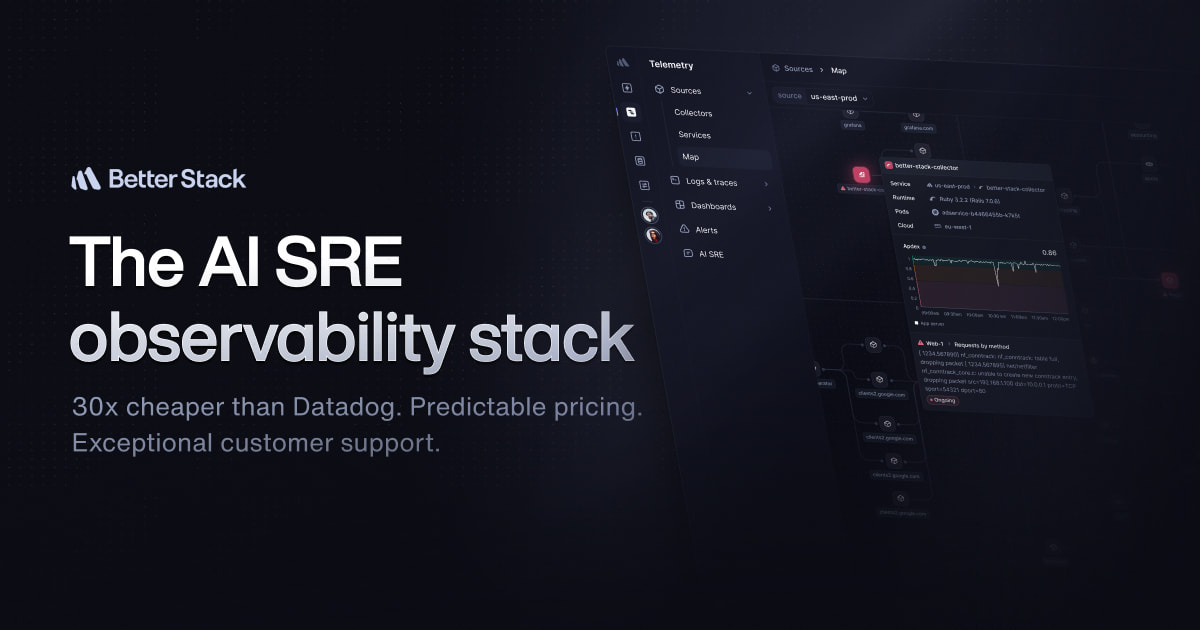
Better Stack is what you get when an uptime monitor and a log viewer merge and keep the pricing page simple.
The company started as Better Uptime and Logtail, folded both into one product, and now sells three things on a single bill: uptime monitoring with status pages, incident management with on-call schedules, and a telemetry backend for logs, traces and metrics.
My opinion up front: for a team under about 20 engineers it is the most predictable observability bill on the market, and that predictability is the product.
This review is for developers and small platform teams deciding whether Better Stack can replace a stack of UptimeRobot plus PagerDuty plus a log tool, or whether it can stand in for Datadog.
I go through what the product includes, how the uptime and telemetry halves work day to day, what each line item costs for the US and Europe data regions, and the real limits: no classic per-host APM, a slow free check interval and a region surcharge that most comparison articles miss.
Five alternatives are priced at the end so you can check the numbers against your own stack.
What is Better Stack?
Better Stack is a hosted monitoring and observability platform built from two earlier products, Better Uptime and Logtail, that now share one account, one pricing page and one incident timeline.
It is sold to developers rather than to enterprise procurement: you sign up with a credit card, the free plan is labelled for personal projects, and every paid line item is a published number.
The Uptime product checks websites, APIs, ping, SSL and domain expiry, DNS, SMTP, POP3 and IMAP, and runs Playwright scripts as transaction monitors. It also hosts status pages on your own subdomain, and the incident side handles on-call schedules, escalation rules, phone calls and SMS.
The Telemetry product stores logs, traces and metrics. It is OpenTelemetry-native, accepts Vector, syslog and Prometheus remote write, and lets you query with SQL or PromQL from drag-and-drop dashboards or a live tail.
Retention is set per source, and the vendor's own pitch is that nothing goes to cold storage: every log stays queryable for its retention window. The same backend powers the real user monitoring add-ons, error tracking with 100,000 free exceptions a month and session replay with 5,000 free replays.
How Better Stack works
Day one is the uptime half. You add a URL, choose a check type and a check interval, pick alert channels (Slack, Teams, e-mail, push, SMS, phone), and point a status page at your domain. Heartbeat monitors cover cron jobs: the job pings a URL on each run and Better Stack alerts when the ping stops.
The free plan checks every 3 minutes; paid monitors go down to 30-second checks, which is the number that matters if your SLA is measured in minutes.
On-call sits on the same incidents. Each person who should be paged needs a Responder license, which unlocks phone and SMS alerts, escalation policies based on time and who is on duty, and one-tap acknowledgement.
People who only need to read dashboards are Team members and cost nothing, so a 12-person team with three people on rotation pays for three seats, not twelve.
The telemetry half is a pipeline. You ship logs with Vector, an OpenTelemetry collector or a platform integration, pick the data region (Virginia, Oregon, Germany or Singapore), and query in SQL or PromQL.
Bundles are sized in GB per month across the three signals, with 30-day retention on the paid tiers, and anything above the bundle is metered per GB ingested and retained.
The region you pick changes the bill: the US-region bundles cost 50% more than the Europe-region ones, and Singapore more again, so the cheap price in most reviews is the European one.
Better Stack key features
Better Stack pricing
Better Stack publishes every price, which already separates it from half the observability market. The figures below were read on Better Stack's pricing page in October 2026; the competitor figures come from Datadog pricing, Grafana Cloud pricing, UptimeRobot pricing, Checkly pricing and New Relic pricing, read the same month.
Three line items make up a Better Stack bill. Monitors beyond the free 10 come in packs of 50 billed yearly, or $25 a month on monthly billing; extra heartbeats come in packs of 10 at $17 yearly ($20 monthly). Each person who gets paged needs a Responder license, $34 a month on monthly billing and less on yearly; Team members who only read dashboards are free. Telemetry is a bundle sized by GB: in the US region, Nano is $38 a month, Micro $150, Mega $315 and Tera $630 billed yearly, and 20% more on monthly billing. The Europe region is cheaper for the same allowances (Nano $25, Micro $100, Mega $210, Tera $420 yearly), and Singapore is dearer. Overage is metered at $0.10 to $0.35 per GB ingested and $0.05 to $0.18 per GB retained, depending on region.
Cost scenario, computed from those rates: a five-person team with 40 HTTP monitors, two people on the on-call rotation and about 40 GB a month of logs in the US region pays for one monitor pack, two responders ($58) and the Nano bundle, which is $117 a month billed yearly, or $1,404 a year. The same team on monthly billing pays $138. Move the data to Germany and the yearly figure drops to $104 a month. For comparison, Datadog's Infrastructure Pro plan alone is $75 a month for five hosts billed annually, before logs (billed per GB ingested and per million indexed events) or APM at $31 per host, and Grafana Cloud's Pro plan starts at a $19 platform fee plus usage.
Devshot data: of the 210 monitoring tools Toolradar tracks as of October 2026, 64% are free, freemium or open source, and the median cheapest paid plan across the 51 tools that publish one is $19 a month. Better Stack's monitor pack sits near that median, and its on-call license is where it moves above it.
| Plan | Price | Best for |
|---|---|---|
| Better Stack Free | $0 | 10 monitors, 10 heartbeats, 1 status page, 3 GB logs and 3 GB traces for 3 days, 30 GB metrics |
| Better Stack extra monitors | $21/mo per 50 (yearly), $25 monthly | 30-second checks, unlimited phone and SMS alerts on paid monitors |
| Better Stack extra heartbeats | $17/mo per 10 (yearly), $20 monthly | Cron and background job monitoring |
| Better Stack Responder | $29/mo per person (yearly), $34 monthly | On-call schedules, escalations, phone and SMS paging; dashboard-only members are free |
| Better Stack Telemetry Nano | $38/mo US region, $25 Europe (yearly) | 40 GB each of logs, traces and metrics, 30-day retention |
| Better Stack Telemetry Micro | $150/mo US region, $100 Europe (yearly) | 160 GB each of logs, traces and metrics |
| Better Stack Telemetry Mega | $315/mo US region, $210 Europe (yearly) | 340 GB each of logs, traces and metrics |
| Better Stack Telemetry Tera | $630/mo US region, $420 Europe (yearly) | 700 GB each of logs, traces and metrics |
| Better Stack overage | $0.10 to $0.35/GB ingested, $0.05 to $0.18/GB retained | Metered above the bundle, rate depends on data region |
| Better Stack status page add-ons | $12/mo per extra page (yearly) | White-label, password, IP allowlist or SSO are $208/mo per page yearly |
| Datadog Infrastructure Pro | $15/host/mo billed annually, $18 on-demand | Metrics and dashboards, 15-month retention; free for up to 5 hosts |
| Datadog APM and logs | $31/host/mo annual; logs $0.10/GB plus $1.70 per million events indexed | Tracing, service maps and indexed log search |
| Grafana Cloud Free | $0 | 10k metric series, 50 GB logs, 50 GB traces, 14-day retention, 3 users |
| Grafana Cloud Pro | $19/mo platform fee plus usage | Metrics from $6.50 per 1,000 series; logs metered per GB for process, write and retain |
| UptimeRobot Free | $0 | 50 monitors at 5-minute checks, 1 status page |
| UptimeRobot paid | Check the current price on UptimeRobot's site | Solo, Team and Scale tiers with 60, 30 and 15-second checks |
| Checkly Hobby | $0 | 10 uptime monitors, 1,000 browser runs, 10,000 API runs a month, 1 user |
| Checkly Starter and Team | $24/mo and $64/mo billed annually | 50 or 75 monitors, 3,000 or 12,000 browser runs, 3 or 10 users |
| New Relic | $0.40/GB after 100 GB free; full users $10 to $349/mo | 1 full-platform user and unlimited basic users free |
Better Stack pros and cons
What we like
- Paid monitors check every 30 seconds, with phone and SMS alerts and escalation included in the responder license.
- Telemetry bundles cover logs, traces and metrics equally, from 40 GB each on Nano to 700 GB each on Tera.
- Dashboard-only team members are free, so a 12-person team on a 3-person rotation pays for 3 seats.
What could be better
- No per-host APM product; traces are a bundle signal, not a service map with profiling.
- US-region bundles cost 50% more than Europe-region ones for the same allowance.
- The free plan checks every 3 minutes and is labelled for personal projects.
Who Better Stack is for
Better Stack fits teams of two to roughly twenty engineers who want one bill for uptime, paging and logs. The per-responder model rewards teams where only a few people take the pager, the status pages are good enough to face customers, and a Nano or Micro bundle covers the log volume of most SaaS products with a handful of services. Teams in Europe get the extra benefit of the cheaper data region.
It is a weaker fit for three kinds of buyer. Teams that need per-host APM with service maps and continuous profiling will find the traces product thinner than Datadog or New Relic.
Teams with more than a few hundred GB of logs a month should price Grafana Cloud and the overage rates carefully, because the Tera bundle ends at 700 GB per signal. And anyone who only needs uptime checks and nothing else gets more free monitors from UptimeRobot, 50 against 10, at a 5-minute interval.
Best Better Stack alternatives
If Better Stack is not the right fit, these are the closest options.
| Tool | Best for | Starts at | |
|---|---|---|---|
| Better Stack | Small engineering teams that want uptime, on-call and logs on one predictable bill. | Free: 10 monitors, 3 GB logs | Visit → |
| Datadog | Teams that need infrastructure, APM, logs and synthetics correlated in one platform and can govern the bill. | Infrastructure Pro $15/host/mo billed annually | Visit → |
| Grafana Cloud | Teams on Prometheus, Loki and Tempo that want managed hosting and the option to self-host later. | Free: 10k metric series, 50 GB logs, 50 GB traces | Visit → |
| UptimeRobot | Solo developers and small sites that only need uptime checks and a status page. | Free: 50 monitors at 5-minute checks | Visit → |
| Checkly | Teams that define monitors as code and want Playwright browser checks as the main product. | Hobby free: 10 monitors, 1,000 browser runs | Visit → |
| New Relic | Teams that want full APM and 100 GB of free ingest, with few people needing full-platform access. | 100 GB/mo ingest and 1 full-platform user free | Visit → |
The bottom line
Better Stack is the right call when the thing you want is a predictable bill for uptime, paging and logs, and your team is small enough that a few responder seats cover the rotation. The published rates, the 30-second checks, the free dashboard seats and the GB-sized bundles are the strengths, and the cost scenario above shows a five-person team landing near $117 a month billed yearly in the US region.
Pick something else in three cases. If you need real APM with service maps and profiling, Datadog or New Relic are the tools, at a higher and less predictable price. If your log volume runs past a few hundred GB a month, Grafana Cloud's open formats and 50 GB free tier deserve a quote. And if you only need uptime checks, UptimeRobot's 50 free monitors or Checkly's monitoring-as-code beat Better Stack's free plan. See our best monitoring tools ranking, the log management comparison, the free uptime monitoring limits, our Datadog alternatives cost model and the Datadog review for the surrounding market, plus the Better Stack and Datadog entries on Toolradar.
Methodology: every price on this page was read on the vendor's own pricing page in October 2026 and the cost scenario is computed from those rates; the category figures come from Toolradar's monitoring statistics as of the same month. No hands-on lab test was run, and this page has no sponsored placement. Cite this: Devshot, "Better Stack Review 2026: Pricing, Uptime and Logs", October 2026.
Frequently asked questions
How much does Better Stack cost?
Is Better Stack worth it?
Does Better Stack have a free plan?
Better Stack vs Datadog: which should a small team pick?
What is the cheapest alternative to Better Stack for uptime only?
Does Better Stack include on-call and phone alerts?
Sources
Prices and plan details come from each vendor's own pricing page, re-checked by the Toolradar pricing tracker.
- Datadog pricingchecked Sep 2026
- Grafana Cloud pricingchecked Sep 2026
- New Relic pricingchecked Sep 2026
Some offers on this page may be paid placements or contain affiliate links.
Get the Devshot brief
Free daily newsletter, read in 5 minutes.
Subscribe free