
Hookdeck Review 2026: Pricing, Pros, Cons and Alternatives
Hookdeck's Event Gateway plans for receiving webhooks and Outpost for sending them, priced at two monthly volumes, with the 2025 price change and Svix, Convoy, Webhook Relay and ngrok side by side.

Hookdeck is worth it in 2026 if webhooks are business-critical and you would rather pay a meter than run queues, retries and alerting yourself. The Event Gateway's Developer plan is free for 10,000 events a month, Team starts at $39 a month and Growth at $499, and events past the allowance are metered. Receiving 1 million events a month on Team costs about $69, and 10 million about $289 (our arithmetic on prices read November 10, 2026).
Sending is cheaper. Outpost, Hookdeck's outbound product, is free to self-host and costs $9.50 for a million events managed, less than a tenth of what Svix's Basic plan charges at the same volume. The catch is the inbound meter: since February 2025 it starts at three times the old per-event rate, so model your volume before you commit.
Key factsBest for: Teams that want inbound webhooks queued, retried and…
- A webhook gateway for receiving events plus Outpost, an open-source service for sending them, both metered per event.
- Free plan: Developer is free with 10,000 events a month, 3-day retention and one user.
- Receiving 1M events: About $69 a month on Team, the plan fee plus metered events (our arithmetic).
- Sending 1M events: Managed Outpost bills $9.50 after its 50,000 free events (our arithmetic).
- Retries: Retries are included in the price of an event on both products.
Pros
- Retries are included in the event price on both products.
- Events above a destination's throughput are queued, never rejected.
- Outpost is Apache 2.0 code you can self-host, and its managed meter was the cheapest we priced.
Cons
- Inbound events up to 5 million cost three times the pre-2025 per-event rate.
- Each destination gets 5 events per second before extra throughput is billed.
- SSO, SLAs and metrics export require the Growth plan.
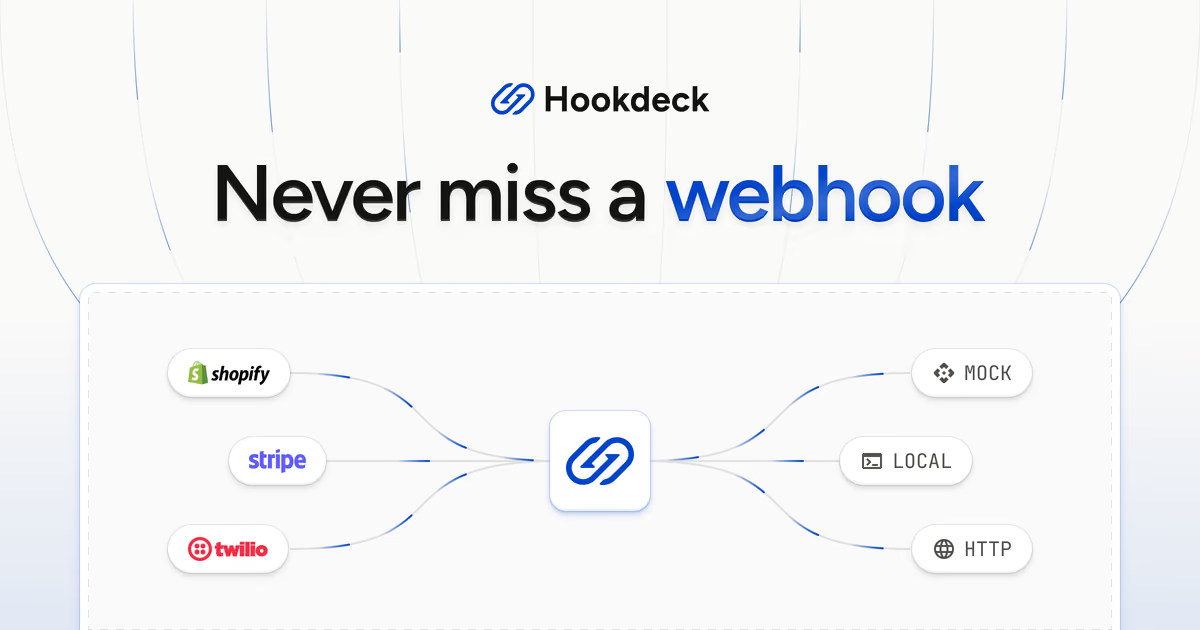
Hookdeck sells two products that solve opposite halves of the webhook problem. The Event Gateway receives webhooks from Stripe, Shopify or GitHub, queues them, retries failures and delivers them to your API at a pace it can absorb. Outpost sends webhooks to your own customers' endpoints, queues and brokers. Most teams need one or the other, and the two are priced on different meters.
Toolradar data: as of November 5, 2026, Toolradar (the software directory we run) files Hookdeck among 221 monitoring tools. Its Team plan ranks joint #44 for price among the 67 that publish a verified entry price, where the median is $20.41 a month. The plan fee sits above the category middle; the event meter, not the plan, is what decides the bill.
This review covers what each plan includes, how events and throughput are counted, what changed in the 2025 repricing, and monthly bills at 1 million and 10 million events against Svix, Convoy, Webhook Relay and ngrok. Every price was read on the vendors' own pricing pages on November 10, 2026.
What is Hookdeck?
Hookdeck is managed webhook infrastructure: a gateway in front of your API for incoming events, and a delivery service for outgoing ones. Its Event Gateway gives every webhook provider a source URL, records each request, applies filters and transformations, and turns it into events delivered to one or more destinations through connections.
Outpost is the sending side. It delivers your events to customer webhooks and to Amazon SQS, RabbitMQ, Google Pub/Sub, AWS EventBridge, Apache Kafka or the Event Gateway, with multi-tenancy, topics, a tenant portal and automatic retries.
Hookdeck publishes it under the Apache 2.0 license and runs the same codebase as its managed service, so you can start self-hosted and move later, or the other way round.
The Event Gateway is the paid core of the business; Outpost is the open-source wedge. For a team that only needs a public URL to test webhooks on a laptop, neither is required: a tunnel such as ngrok does that job.
How Hookdeck works
Hookdeck counts two things on the Event Gateway. A request is any inbound HTTP call to one of your sources. An event is a request delivered to a destination, so one request can create zero, one or several events depending on your connections.
Every plan includes 10,000 events a month and 100,000 discarded requests, the ones your filters drop; past that, discarded requests cost $2.50 per million.
Retries cost nothing extra, because the price of an event includes all its attempts. That matters during an outage on your side: a provider's burst of failures does not multiply your bill the way a per-attempt meter would.
Billing is pro-rated in 10,000-event blocks, so a month just over a boundary costs one extra block, not a full tier.
Throughput is the second limit. Each destination receives up to 5 events per second per project at no charge, and Hookdeck queues anything above that instead of rejecting it, with extra throughput priced in the same calculator.
Ten million events in a 30-day month average about 3.9 per second (our arithmetic), so a destination at that volume will queue at every peak unless you buy more throughput.
On the free Developer plan, going past 10,000 events does not drop traffic: Hookdeck keeps receiving, locks the dashboard until you upgrade or the month resets, and reserves the right to stop processing after excessive overages. A 14-day trial lets you invite teammates, and no credit card is required to sign up.
Hookdeck key features
Hookdeck pricing
Hookdeck's Event Gateway pricing page, read on November 10, 2026, lists the plans in the table below. The plan fee buys features, retention and seats; the meter buys volume. All three self-serve plans include the same 10,000 events, and the page's calculator prices additional events at $3.00 per 100,000 up to 5 million, then at falling rates with volume. Plans are shown as monthly prices, with a startup discount on Growth for eligible companies.
Two monthly bills, our arithmetic from the calculator: receiving 1 million events on Team costs about $69, the plan fee plus about $30 of events. At 10 million the events come to about $250 and the total to about $289, before any throughput upgrade or the static IP add-on. For the same volumes, Webhook Relay Pro at $224.99 a month on yearly billing includes 1 million webhooks, with extra webhooks at $100 per million, or $1,124.99 at 10 million. Convoy sells cloud plans from $99 a month at a flat price with a throughput cap and no per-message meter.
The meter got more expensive in early 2025. A copy of the pricing page archived on January 17, 2025 listed Team at $29 and Growth at $99, with 100,000 events included on both and additional events at $1.00 per 100,000. By February 12, 2025 both plans had moved to today's prices and the first tier to $3.00 per 100,000. On those old rates, 1 million events on Team came to $38 and 10 million to $128 (our arithmetic), so the same workloads cost roughly 1.8 and 2.3 times more today. The static IP add-on moved the other way, from $150 in late 2025 to its current price.
Outbound is where Hookdeck is cheapest. Outpost managed Starter bills $10 per million events after 50,000 free ones, in 10,000-event chunks, with uncapped throughput: $9.50 at 1 million and $99.50 at 10 million (our arithmetic). Svix Basic charges $20 a month plus $0.0001 per message after 50,000, so $115 and $1,015 at the same volumes. One caution: Outpost counts an event per destination, so a message fanned out to two endpoints is billed twice.
| Plan | Price | Best for |
|---|---|---|
| Event Gateway Developer | $0 | 10,000 events a month, 3-day retention, one user, SOC 2 compliance |
| Event Gateway Team | From $39/mo plus metered events | Unlimited users, 7-day retention, pay-as-you-go events, alert integrations such as Slack and PagerDuty |
| Event Gateway Growth | From $499/mo plus metered events | Uptime and latency SLAs, 30-day retention, metrics export, SSO, SAML and SCIM, HIPAA compliance |
| Event Gateway Enterprise | Custom | Premium support, a support manager, Slack Connect, custom SLAs and contracts |
| Additional events | $3.00 per 100k up to 5M, lower above | Billed in 10,000-event blocks; retries included in each event |
| Static IP add-on | +$100 | Deliveries from a fixed set of IP addresses, available on every plan |
| Outpost self-hosted | Free | Apache 2.0 open-source code, runs on any cloud, community support |
| Outpost Starter (managed) | $10 per million events | First 50,000 events free, uncapped throughput, unlimited seats, 7-day retention |
| Outpost Growth (managed) | From $499/mo + $10 per million events | 99.99% uptime SLA, 30-day retention, SSO and SCIM, HIPAA, US, EU and Asia regions |
Hookdeck pros and cons
What we like
- Retries are included in the event price on both products.
- Events above a destination's throughput are queued, never rejected.
- Outpost is Apache 2.0 code you can self-host, and its managed meter was the cheapest we priced.
What could be better
- Inbound events up to 5 million cost three times the pre-2025 per-event rate.
- Each destination gets 5 events per second before extra throughput is billed.
- SSO, SLAs and metrics export require the Growth plan.
Who Hookdeck is for
Hookdeck fits a backend team whose revenue depends on webhooks arriving: payment confirmations, order events, repository hooks. Team is the right start for most production workloads under a few million events a month, where the fee plus the meter still costs less than an engineer's time spent on a home-built queue.
Growth is for companies that need a contractual SLA, SSO or HIPAA, at a price that only makes sense once webhooks are core infrastructure.
Outpost suits a SaaS company that must send webhooks to its own customers. Self-hosting is free if you already run Kubernetes or Docker; the managed meter undercuts Svix by a wide margin at every volume we priced.
Svix still earns a look if you want its consumer portal and connectors on a free tier, and our Inngest vs Trigger.dev comparison covers the case where a webhook only kicks off a background job.
Skip Hookdeck if you only need to expose localhost while you build an integration: our ngrok review and ngrok alternatives cover tunnels.
Skip it too if your events already land on AWS and a queue in front of a Lambda will do, in which case read AWS Lambda pricing first.
Best Hookdeck alternatives
If Hookdeck is not the right fit, these are the closest options.
| Tool | Best for | Starts at | |
|---|---|---|---|
| Hookdeck | Teams that want inbound webhooks queued, retried and monitored, or outbound webhooks sent without building it. | Free plan · Team $39/mo · Growth $499/mo · custom-priced plans too | Visit → |
| Svix | SaaS teams that want a hosted outbound webhook service with an embeddable consumer portal. | Free plan · Basic $20/mo · Professional $490/mo · custom-priced plans | Visit → |
| Convoy | Teams that want one open-source gateway for incoming and outgoing webhooks at a flat monthly price. | Free plan · Premium $999/mo · custom-priced plans too | Visit → |
| Webhook Relay | Small teams and home labs that want webhook forwarding, tunnels and outbound webhooks on one bundle. | Free for 150 webhooks/mo | Visit → |
| ngrok | Developers who only need a public URL to receive test webhooks on a local machine. | Free plan · Hobbyist $10/mo · custom-priced plans too | Visit → |


The bottom line
Buy Hookdeck when a lost webhook costs you money and your volume is in the low millions a month; look harder at the meter above that. Team gives a production-grade receiving pipeline at a modest monthly cost for 1 million events, but the 2025 repricing makes 10 million several times dearer than a flat-priced gateway such as Convoy. On the sending side, managed Outpost is the cheapest metered option we priced, and its open-source license removes the lock-in worry.
Before you sign up, count your events per destination rather than your requests, check your peak rate against the 5-per-second throughput floor, and price both Hookdeck products if you send and receive. For the rest of the stack, see our guides to API gateways, monitoring tools and dev tools for startups, the Upstash review for serverless queues and ngrok pricing.
Methodology: Hookdeck's plans, meter and add-ons were read on its Event Gateway and Outpost pricing pages on November 10, 2026, past prices on dated Wayback Machine copies of the Event Gateway page, and rival prices on the Svix, Convoy, Webhook Relay and ngrok pricing pages the same day. Scenario totals are our arithmetic on list prices before tax, on a 30-day month. Devshot gives no star rating.
Cite this: Devshot, "Hookdeck Review 2026: Pricing, Pros, Cons and Alternatives", November 2026.
Frequently asked questions
Is Hookdeck worth it in 2026?
How much does Hookdeck cost?
What counts as an event in Hookdeck?
Did Hookdeck raise its prices?
Hookdeck vs Svix: which is cheaper for sending webhooks?
Some offers on this page may be paid placements or contain affiliate links.
Get the Devshot brief
Free daily newsletter, read in 5 minutes.
Subscribe free