
Upstash Review
What Upstash Redis costs per command, per Fixed tier and per production add-on, with the break-even points and four managed alternatives priced beside it.

Upstash is worth it in 2026 for serverless and edge apps whose Redis traffic is light or spiky. Pay as you go costs $0.20 per 100K commands with no monthly minimum, and the free tier covers 250 MB and 500K commands a month, verified on Upstash's pricing page on October 19, 2026.
The catch is that per-command billing gets expensive past about 5 million commands a month, where a flat Fixed plan costs less. A production SLA is a separate Prod Pack at $200 a month per database, so a small cache with a contract behind it costs far more than its sticker. For a steady, busy workload, compare the serverless platforms it runs beside and the managed Redis options below.
Key factsBest for: Serverless and edge apps that call Redis over HTTP with…
- Managed Redis with a REST API, billed per command or at a flat monthly tier.
- Free tier: 250 MB and 500K commands a month
- Fixed plans: Seven flat tiers, 250 MB to 500 GB
- Alternatives covered: Redis Cloud, Amazon ElastiCache Serverless, Cloudflare Workers KV, Momento
Pros
- Pay as you go has no monthly minimum, and AUTH, PING and other operational commands are not billed.
- A monthly budget with alerts at 70% and 90% caps the pay-as-you-go bill instead of only warning you.
- Seven Fixed tiers, up to 500 GB of data, remove the command meter entirely, so a busy month costs the same as a quiet one.
Cons
- On a busy database, per-command billing costs more than the smallest Fixed tier, and the gap widens as traffic grows.
- The uptime SLA, multi-zone HA and SOC 2 report sit in Prod Pack, a separate monthly fee for every database.
Upstash sells Redis that you reach over a REST API as well as the normal protocol, which is why it shows up in Vercel, Cloudflare and other edge stacks where a long-lived TCP connection is awkward. The pricing model is the product: you either pay per command, or you pay a flat monthly price for a data size and a bandwidth allowance.
That split makes it cheap for a side project and a budgeting exercise for anything busy. The free tier stops at a hard monthly command count, pay as you go bills from the first command once a card is on file, and Fixed plans trade the meter for a ceiling on data and bandwidth.
Toolradar data: Toolradar, the software directory we run, tracks 54 serverless tools as of October 19, 2026, and Upstash's entry paid plan sits exactly at the median entry price of the 20 serverless tools with a comparable verified price, according to its Upstash page.
The same data shows 83% of the tools in the serverless ranking have a free plan, so a free tier is table stakes here, not a differentiator.
How we compared: every price was read on the vendor's own page on October 19, 2026: Upstash Redis pricing, Redis Cloud pricing, Amazon ElastiCache pricing (US East, N.
Virginia), Workers KV pricing and Momento pricing (us-east-1). Monthly costs below are our arithmetic on those list prices; we did not run workloads on any of them.
What is Upstash?
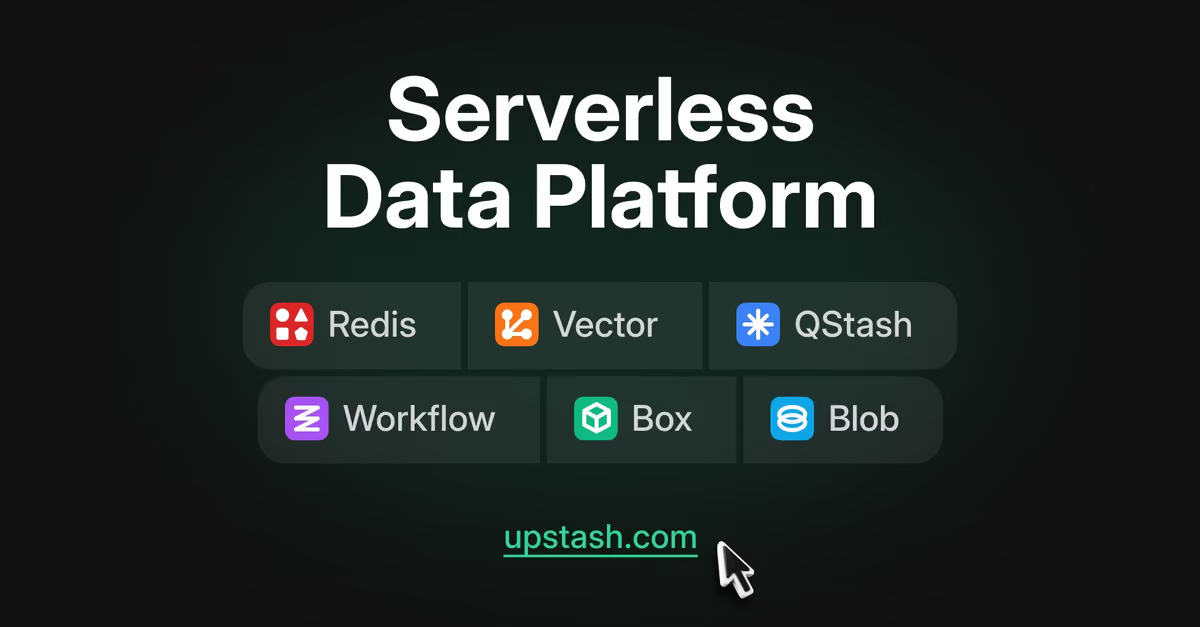
Upstash is a serverless data platform whose best-known product is managed Redis. Its pricing page lists Redis next to Vector, QStash, Workflow, Box and Blob, but the Redis meter is the one most developers meet first.
A database runs on AWS, GCP or Fly, with Vercel as a supported platform, and every plan supports persistence, the REST API and global replication. Global replication adds read regions near your users, and every write is also counted in each read region, which matters on the per-command plan.
There is also a no-signup path: a POST request to Upstash's start endpoint returns a free database with credentials, aimed at AI agents and quick demos. That database is deleted after 3 days unless you claim it into an account, so treat it as a scratchpad, not a place to keep data.
If the job is a full backend with auth and files, Upstash is one piece of it. The backend-as-a-service ranking covers products that bundle those parts.
How Upstash works
You create a database, pick a region and a plan, then connect with a Redis client or the HTTP API. Pay as you go bills commands, storage and bandwidth: commands at the per-100K rate, storage at $0.25 per GB past the first free gigabyte, and bandwidth free up to 200 GB a month, then $0.03 per GB.
Reads and writes cost the same. Operational commands such as AUTH, PING, INFO and SELECT are not charged, so connection chatter does not inflate the bill. On a global database, one primary plus one read region doubles the cost of each write, because the replication is counted as a command.
Fixed plans drop the command meter. You pay a flat monthly price for a data size and a bandwidth allowance, plus a per-region fee for each read region. When a Fixed database hits its storage or bandwidth limit, it upgrades to the next tier if auto-upgrade is on; if not, writes or traffic are blocked.
The pay-as-you-go plan has an optional monthly budget. Upstash emails at 70% and 90% of it, and past the cap the database is rate limited so the total never exceeds the budget. That is a real brake, but it brakes your app too, so set it above your busiest month.
Upstash key features
Upstash pricing
Upstash publishes every Redis price except Enterprise, so the bill is something you can model before you sign up. Paid databases get no free allowance: once you upgrade, the first command and the first megabyte are billed under that plan.
The break-even is simple arithmetic. The cheapest Fixed tier equals pay as you go at 5 million commands a month, and the 1 GB tier equals it at 10 million. A cache doing 30 million commands a month costs $60 on pay as you go and $20 on Fixed 1GB, if its data fits in a gigabyte and its traffic fits in 100 GB of bandwidth.
Scale makes the gap wider. At 100 million commands with 5 GB of data, pay as you go comes to $201 a month (commands plus four billable gigabytes of storage), against $100 on Fixed 5GB. Going the other way, a database doing 2 million commands a month pays $4 on pay as you go, well under any Fixed tier.
Production is where the sticker misleads. Prod Pack is billed per database, so a Fixed 250MB cache with an SLA costs $210 a month, and three such databases cost $630. Accounts get 10 databases free, then $0.5 per active database up to 100.
Against the alternatives: Redis Cloud Essentials has a flat monthly total for its smallest size, and ElastiCache Serverless for Valkey has a 100 MB storage floor at $0.084 per GB-hour, about $6 a month before requests at a 730-hour month.
The free database hosting list covers the free tiers in more depth.
| Plan | Price | Best for |
|---|---|---|
| Upstash Free | $0 | 250 MB data, 10 GB bandwidth and 500K commands a month |
| Upstash Pay as you go | $0.20 per 100K commands | Up to 100 GB data, unlimited commands, first 1 GB of storage free |
| Upstash Fixed 250MB | $10/month | 250 MB data, 50 GB bandwidth, plus a fee per read region |
| Upstash Fixed 1GB | $20/month | 1 GB data, 100 GB bandwidth, plus $10 per read region |
| Upstash Fixed 5GB | $100/month | 5 GB data, 500 GB bandwidth, plus $50 per read region |
| Upstash Fixed 10GB | $200/month | 10 GB data, 1 TB bandwidth, plus $100 per read region |
| Upstash Fixed 50GB | $400/month | 50 GB data, 5 TB bandwidth, plus a fee per read region |
| Upstash Fixed 100GB | $800/month | 100 GB data, 10 TB bandwidth, plus $400 per read region |
| Upstash Fixed 500GB | $1,500/month | 500 GB data, 20 TB bandwidth, 16,000 commands per second |
| Upstash Prod Pack | +$200/month per database | Uptime SLA, multi-zone HA, encryption at rest, SOC 2 report |
| Upstash Enterprise | Custom | 100K+ commands per second, HIPAA, dedicated resources |
| Redis Cloud Essentials | $5/month | Shared deployment, 250 MB to 100 GB, single database |
| Redis Cloud Pro | From $0.014/hour | Dedicated deployment with a monthly minimum spend |
| ElastiCache Serverless for Valkey | $0.084/GB-hour | US East example, plus $0.0023 per million ECPUs, 100 MB minimum |
| Cloudflare Workers Paid | $5/month minimum | Includes 10 million KV reads and 1 million writes a month |
| Momento Cache Flex | From $13 per GB-month | Fully managed Valkey, us-east-1 pricing |
Upstash pros and cons
What we like
- Pay as you go has no monthly minimum, and AUTH, PING and other operational commands are not billed.
- A monthly budget with alerts at 70% and 90% caps the pay-as-you-go bill instead of only warning you.
- Seven Fixed tiers, up to 500 GB of data, remove the command meter entirely, so a busy month costs the same as a quiet one.
What could be better
- On a busy database, per-command billing costs more than the smallest Fixed tier, and the gap widens as traffic grows.
- The uptime SLA, multi-zone HA and SOC 2 report sit in Prod Pack, a separate monthly fee for every database.
Who Upstash is for
Upstash fits a developer whose Redis calls come from functions, not from a long-running server. Rate limiting, session data, feature flags and small caches on Vercel or Cloudflare are the natural fit, because the REST API works where a socket pool does not.
It also fits a side project that needs a real Redis without a monthly fee. The free tier has hard command and size limits, so plan the upgrade before a launch rather than discovering the ceiling on launch day.
Skip Upstash for a busy, steady workload on a server you already run. A process that keeps one connection open and fires thousands of commands a second is the case where a provisioned instance or Redis Cloud Pro is the comparison to make, and per-command pricing loses.
Skip it too if your compliance team needs an SLA but the budget cannot absorb a per-database add-on.
If the database you actually need is Postgres, the Neon review covers the same pay-for-what-runs idea for SQL, and the Supabase review covers a full backend.
Devshot data: this newsletter goes to 30,000+ developers, and the audience file updated November 1, 2026 shows a 32% average open rate. Subscribe free to get the next pricing change in your inbox.
Best Upstash alternatives
If Upstash is not the right fit, these are the closest options.
| Tool | Best for | Starts at | |
|---|---|---|---|
| Upstash | Serverless and edge apps that call Redis over HTTP with light or spiky traffic | Pay as you go $0.20 per 100K commands | Visit → |
| Redis Cloud | Teams that want Redis from Redis itself, with SSO and RBAC on the entry plan | Free up to 30 MB | Visit → |
| Amazon ElastiCache Serverless | AWS accounts that want a serverless cache inside their own VPC | Valkey from $0.084/GB-hour plus $0.0023 per million ECPUs (US East) | Visit → |
| Cloudflare Workers KV | Read-heavy config and lookup data for apps already on Cloudflare Workers | Workers Paid $5/month minimum includes 10M reads | Visit → |
| Momento | Teams that want fully managed Valkey priced by memory rather than by request | Cache Flex from $13 per GB-month | Visit → |


The bottom line
Upstash is worth paying for when your Redis lives behind functions and its traffic is light or uneven. Start on the free tier, set a budget the day you add a card, and move to a Fixed tier once the monthly command count passes the break-even.
Choose Redis Cloud when you want the vendor's own Redis with SSO on the entry plan. Choose ElastiCache Serverless when the account is already AWS and the cache should stay in your VPC.
Choose Workers KV when the data is read-heavy config on Cloudflare and you do not need Redis data types, and Momento when you would rather pay for memory than for commands.
The Cloudflare Workers pricing breakdown and the Vercel review cover the platforms Upstash usually runs beside.
The Devshot brief tracks infra pricing changes like these. Subscribe free if you want the next one in your inbox.
Cite this: Devshot, "Upstash Review 2026", November 2026.
Frequently asked questions
Is Upstash worth it in 2026?
How much does Upstash Redis cost?
Does Upstash have a free tier?
When is an Upstash Fixed plan cheaper than pay as you go?
How does Upstash compare with Redis Cloud?
Some offers on this page may be paid placements or contain affiliate links.
Get the Devshot brief
Free daily newsletter, read in 5 minutes.
Subscribe free