
PostHog Review
What the free tier covers on each PostHog product, what the usage meters charge once you cross it, a computed monthly bill for a typical startup, and how it compares with Mixpanel, Amplitude, Statsig and LaunchDarkly.

PostHog is worth it for a product team that wants analytics, session replay, feature flags, experiments, surveys and error tracking on one usage meter, and it is the cheapest of the five tools here until you pass a few million events a month. Every product has a monthly free allowance, 1M events, 5K recordings, 1M flag requests and 100K exceptions, and there is no seat charge, read on PostHog's pricing page in October 2026. Above the allowance you pay per unit: $0.00005 per event up to 2M, then $0.0000343 to 15M. A startup at 3M events, 20K recordings and 1.5M flag requests pays about $202 a month. The catch is that the meters add up across products and the platform packages (Boost $250, Scale $750, Enterprise $2,000 a month) are where SSO, SAML and HIPAA live. Mixpanel and Amplitude are the pure analytics alternatives, Statsig the experimentation one, LaunchDarkly the flag specialist.
Key factsBest for: Product teams that want analytics, replay, flags…
- Open-source product platform with a monthly free allowance on every module and per-unit pricing above it.
- Free allowance: 1M events, 5K recordings and 1M flag requests every month
- Seats: Unlimited on every plan, including free
- Startup at 3M events: About $202 a month with 20K recordings and 1.5M flag requests
- Platform packages: Boost, Scale and Enterprise are flat monthly fees on top of usage
Pros
- 1M events, 5K recordings, 1M flag requests and 100K exceptions free every month, no card required.
- No per-seat charge on any plan, so the whole company can view dashboards.
- Billing limits per product pause ingestion at your cap instead of charging more.
Cons
- The first paid band of each meter is the dearest per unit, and that band is where most startups sit.
- SSO enforcement, HIPAA BAA and SAML sit in the Boost and Scale packages, not in pay-as-you-go.
- Each module is shallower than its specialist rival; LaunchDarkly and Sentry keep features PostHog lacks.
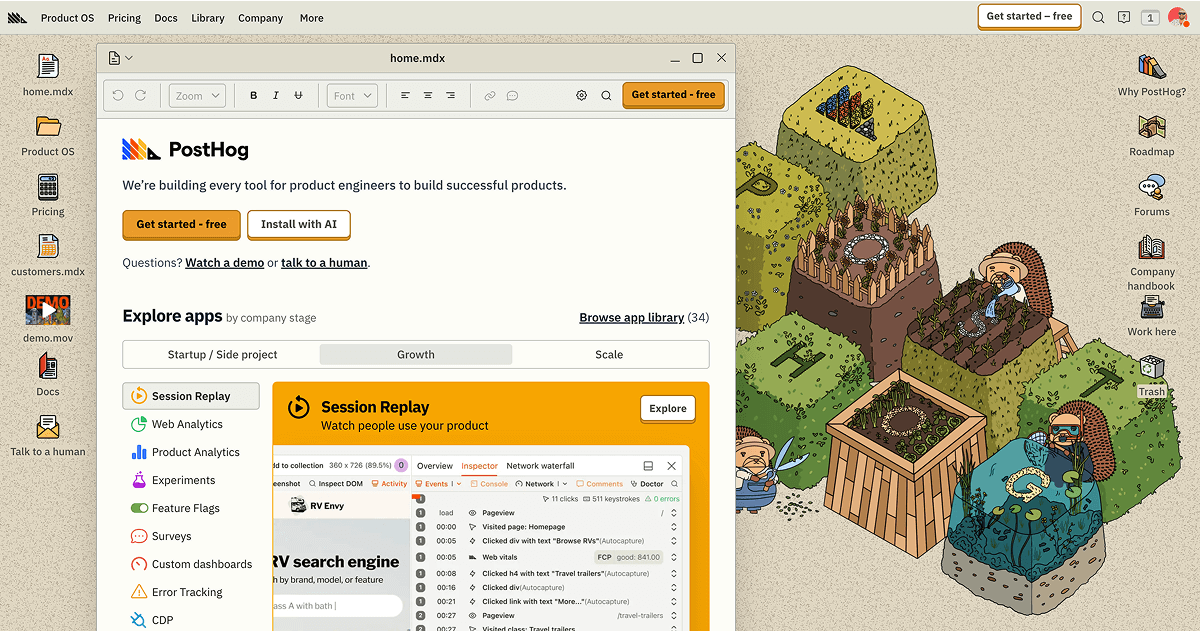
PostHog's pricing reads like a bet against its own sales team: no base fee, no seats, a free allowance on every product that resets monthly, and a billing limit you can set per product so a traffic spike cannot run up a bill you did not approve.
My view after reading the whole price list: it is the best deal in product analytics for a team under roughly 2M events a month, and a genuinely competitive one above that, as long as you watch the flag and replay meters as closely as the event meter.
This review is for developers and product engineers choosing between PostHog and the specialist tools it replaces.
I cover what the platform bundles, how the usage meters and billing limits work, what each product costs past the free allowance, a computed bill for a realistic startup, who should skip it, and the four closest alternatives priced from their own pages in October 2026.
What is PostHog?
PostHog is an open-source product platform that packages the tools a product team otherwise buys separately: product analytics, web analytics, session replay, feature flags, A/B experiments, surveys, error tracking, a data warehouse with pipelines, logs and AI observability.
It runs as a hosted service in US or EU cloud regions, and the open-source edition can be self-hosted.
The pitch is that one event stream feeds everything. A feature flag exposure becomes an experiment variant, a conversion drop in a funnel links to the session recordings that produced it, and an exception in error tracking carries the user's replay.
For a small team that means one SDK, one data model and one bill instead of a Mixpanel plus LogRocket plus LaunchDarkly plus Sentry stack.
The trade-off is depth per product. Each PostHog module competes with a specialist that does only that job; replay competes with FullStory and LogRocket, flags with LaunchDarkly, error tracking with Sentry.
PostHog wins on integration and price, and loses where a team needs the specialist's advanced features, for example LaunchDarkly's approval workflows or Sentry's performance tracing.
How PostHog works
You install one SDK (web, mobile or server) and every product bills on its own unit: events for analytics, recordings for replay, requests for flags, responses for surveys, exceptions for error tracking, rows for the warehouse.
Each product has a free monthly allowance, and you only add a card when you want to exceed one of them. Past the allowance, volume tiers lower the unit price as usage grows, so the marginal cost of event 10 million is lower than that of event 2 million.
Two controls keep the bill predictable. A billing limit per product caps spend: when a product hits its cap, PostHog stops ingesting that product's data for the rest of the month rather than charging more. And the free plan stops at the allowance by design, so a project with no card attached can never be billed.
The paid plan, called pay-as-you-go, adds the same allowances plus six projects, seven-year data retention and email support, against one project and one-year retention on the free plan.
Platform packages sit on top of usage. Boost adds unlimited projects, white labeling, a HIPAA BAA and SSO enforcement; Scale adds SAML and priority support; Enterprise adds role-based access control, dedicated support and training.
Session recordings are kept one month on the free plan and 90 days on pay-as-you-go, extendable to a year with Boost or Scale and five years with Enterprise.
PostHog key features
PostHog pricing
All prices below were read on PostHog's pricing page in October 2026, and competitor prices on Mixpanel pricing, Amplitude pricing, Statsig pricing and LaunchDarkly pricing the same month. PostHog prices in USD with no base fee and no seat charge.
Each product meters separately after its free allowance. Feature flag requests cost $0.0001 each from 1M to 2M, $0.000045 from 2M to 10M and $0.00001 above 50M. Survey responses are $0.10 each from 1,500 to 2,000, then $0.035 to 10,000 and $0.01 above 20,000. Error tracking exceptions are $0.00037 each from 100K to 325K, falling to $0.000115 above 10M. Data warehouse rows are $0.000015 each from 1M to 10M and $0.000001 above 1B. Group analytics and data pipelines are add-ons with their own 1M free events and per-event rates between $0.0000697 and $0.000026 depending on volume. Logs keep 14 days by default; longer retention is $0.05 per GB per month.
Cost scenario, computed from those rates: a startup at 3M events, 20K session recordings and 1.5M flag requests a month pays $50 for the second million events plus $34.30 for the third, $50 for recordings 5K to 15K plus $17.50 for the next 5K, and $50 for the half million flag requests above the allowance: about $202 a month, with no seat fees for any team size. Flags are the meter to watch: a client-side flag evaluated on every page load burns requests faster than events, and at 5M requests a month that line alone is $235. At 10M events with everything else inside the allowance, analytics costs $324.40.
Mixpanel's Growth plan prices 2M events at $185 a month and 5M at $438 on annual billing, so the same 3M-event startup lands between those figures and gets no flags or error tracking. Amplitude gives 2M events free on its Plus plan and prices above that in its calculator, so a team at 3M should check the current price on Amplitude's site. Statsig Pro is $150 a month for 5M events with unlimited flag checks and 100K replays, the strongest rival at this exact volume. LaunchDarkly's Foundation plan prices flags per service connection and per 1K client-side monthly active users (billed yearly), a different unit that favours server-side apps with few connections.
Devshot data: Toolradar tracks 83 product analytics tools as of October 2026, and 58% of them are free, freemium or open source. PostHog sits in the freemium majority, so a free allowance is table stakes in this category; what separates it is that the allowance covers six products, not one.
| Plan | Price | Best for |
|---|---|---|
| PostHog Free | $0 | Full monthly allowance on every product, 1 project, 1-year retention, community support |
| PostHog Pay-as-you-go | No base fee; usage above the allowances | 6 projects, 7-year retention, email support, billing limits per product |
| PostHog product analytics | 1M events free, then $0.00005/event to 2M, $0.0000343 to 15M, $0.0000295 to 50M | Falls to $0.000009 per event above 250M |
| PostHog session replay | 5K recordings free, then $0.005 each to 15K, $0.0035 to 50K | Falls to $0.0015 above 500K; 90-day retention on pay-as-you-go |
| PostHog feature flags and experiments | 1M requests free, then $0.0001 to 2M, $0.000045 to 10M | Experiments billed with flags; $0.00001 per request above 50M |
| PostHog error tracking | 100K exceptions free, then $0.00037 each to 325K | Falls to $0.000115 above 10M exceptions |
| PostHog surveys | 1,500 responses free, then $0.10 each to 2,000, $0.035 to 10,000 | $0.01 per response above 20,000 |
| PostHog Boost | $250/mo | Unlimited projects, white labeling, HIPAA BAA, SSO enforcement |
| PostHog Scale | $750/mo | Everything in Boost plus SAML and priority support |
| PostHog Enterprise | $2,000/mo | Role-based access control, dedicated support, training, 5-year replay retention |
| Mixpanel Growth | From $0; $185/mo at 2M events, $438/mo at 5M (annual) | 1M events and 10K replays free, up to 20M events and 500K replays |
| Amplitude Plus | From $0; first 2M events free, event-based above | Up to 70M events, 10K replays, unlimited flags, 2-year retention |
| Statsig Pro | $150/mo | 5M events, unlimited flag checks, 100K replays; $0.05 per 1K events over |
| LaunchDarkly Foundation | $10 per service connection, $8.33 per 1K client MAU a month | Pay as you go, 14-day trial, 5K AI runs included |
PostHog pros and cons
What we like
- 1M events, 5K recordings, 1M flag requests and 100K exceptions free every month, no card required.
- No per-seat charge on any plan, so the whole company can view dashboards.
- Billing limits per product pause ingestion at your cap instead of charging more.
What could be better
- The first paid band of each meter is the dearest per unit, and that band is where most startups sit.
- SSO enforcement, HIPAA BAA and SAML sit in the Boost and Scale packages, not in pay-as-you-go.
- Each module is shallower than its specialist rival; LaunchDarkly and Sentry keep features PostHog lacks.
Who PostHog is for
PostHog fits a product or engineering team that would otherwise buy three or four tools and is under a few million events a month: the whole stack is free until then, and the one-SDK, one-data-model design saves the integration work of stitching Mixpanel to LogRocket to LaunchDarkly.
It also fits a company that hates seat pricing, because 40 viewers cost nothing extra. See our feature flag platforms and error tracking tools rankings for how its modules compare one by one.
It is the wrong default for a team that needs one module at a specialist's depth: LaunchDarkly's approval workflows and release monitoring, Sentry's tracing and profiling, Amplitude's behavioral cohorts at enterprise scale.
It is also the wrong default for a company that needs SAML and SSO enforcement on day one, since those sit behind the Boost and Scale packages rather than the usage price. And a high-traffic consumer app evaluating client-side flags on every page view should model the flag meter before signing, because requests outrun events quickly.
Best PostHog alternatives
If PostHog is not the right fit, these are the closest options.
| Tool | Best for | Starts at | |
|---|---|---|---|
| PostHog | Product teams that want analytics, replay, flags, experiments and error tracking on one usage meter. | Free: 1M events, 5K recordings, 1M flag requests a month | Visit → |
| Mixpanel | Teams that want deeper product analytics and session replay without flags or error tracking. | Free: 1M events and 10K replays a month | Visit → |
| Amplitude | Product teams that want the largest free event allowance and enterprise-grade behavioral analytics later. | Free: 2M events and 10K replays a month, unlimited flags | Visit → |
| Statsig | Teams that run many experiments and want flag checks unmetered. | Developer free: 2M events, 50K replays, unlimited flag checks | Visit → |
| LaunchDarkly | Engineering orgs that need approval workflows, release monitoring and enterprise flag governance. | Developer free: 5 service connections, 1K client MAU | Visit → |
The bottom line
Buy PostHog if you want the whole product stack on one meter and your traffic is still measured in single-digit millions of events. The free allowances cover a pre-launch product entirely, the computed startup bill replaces three subscriptions, and billing limits remove the usual fear of usage pricing. Model the flag meter before you rely on client-side flags at scale.
Skip it if one module has to be best in class or you need SAML on day one. Statsig is the sharper pick for heavy experimentation at a flat $150, LaunchDarkly for flag governance, Mixpanel and Amplitude for analytics depth, and Sentry for error tracking with tracing. See also our best feature flag platforms, best error tracking tools, best monitoring tools and best log management tools rankings, the LaunchDarkly alternatives and Datadog alternatives guides, and the PostHog, Mixpanel, Amplitude and Statsig entries on Toolradar.
Methodology: every price and allowance on this page was read on the vendor's own pricing page in October 2026, the cost scenarios are computed from PostHog's published volume tiers, and the category figure comes from Toolradar's product analytics listing as of the same month. No hands-on lab test was run, and this page carries no sponsored placement. Cite this: Devshot, "PostHog Review 2026: Pricing, Free Tier, Pros and Cons", October 2026.
Frequently asked questions
How much does PostHog cost in 2026?
Is PostHog free?
PostHog vs Mixpanel: which is cheaper?
Does PostHog charge per seat?
What are PostHog's weaknesses?
Does PostHog offer a startup discount?
Sources
Prices and plan details come from each vendor's own pricing page, re-checked by the Toolradar pricing tracker.
- PostHog pricingchecked Sep 2026
Some offers on this page may be paid placements or contain affiliate links.
Get the Devshot brief
Free daily newsletter, read in 5 minutes.
Subscribe free