
Storyblok Review 2026: Pricing, Pros, Cons and Alternatives
Seats, traffic, locales and API requests on each Storyblok plan, the add-on math that decides Growth versus Growth Plus, and how the bill compares with Sanity, Prismic, Hygraph and Payload.

Storyblok is worth it in 2026 for marketing-led sites where editors need a visual page builder, and it costs $99 a month on Growth billed monthly, or $90.75 a month billed annually, for 5 seats, 400GB of traffic and 1M API requests, per Storyblok's pricing page on November 9, 2026. Starter is free for one person.
The real cost is add-ons. A 10-person team on Growth pays $174 a month before any extra traffic or locales, by our arithmetic, and once add-ons pass $250 a month the $349 Growth Plus plan is cheaper. Developers who want GraphQL, environments or SSO need a custom Premium contract.
Key factsBest for: Marketing-led teams that want a visual page builder on top…
- A component-based headless CMS whose Visual Editor lets editors assemble pages on a live preview.
- Free plan: Starter is free for 1 seat, 100GB of traffic, 100k API requests and 2 locales.
- Growth seats: Growth includes 5 seats and sells extra seats at $15 each, up to 10 in total.
- Switch point: Growth Plus becomes the cheaper plan once Growth add-ons pass $250 a month, by our arithmetic.
- Toolradar data: Storyblok is listed as an alternative to 19 tools, joint #7 of the 49 Headless CMS tools Toolradar tracks, November 2026.
Pros
- The Visual Editor is on every plan, including the free Starter.
- Every new space gets a 45-day Growth Plus trial with no credit card.
- Growth Plus bundles 15 seats, 1TB of traffic and 10 locales at one fixed price.
Cons
- Billing is per space, so each extra project is another subscription.
- GraphQL, environments and SSO are listed only on custom Premium and Elite plans.
- Two months over the API and traffic limits can trigger a breach fee of up to $1,000.
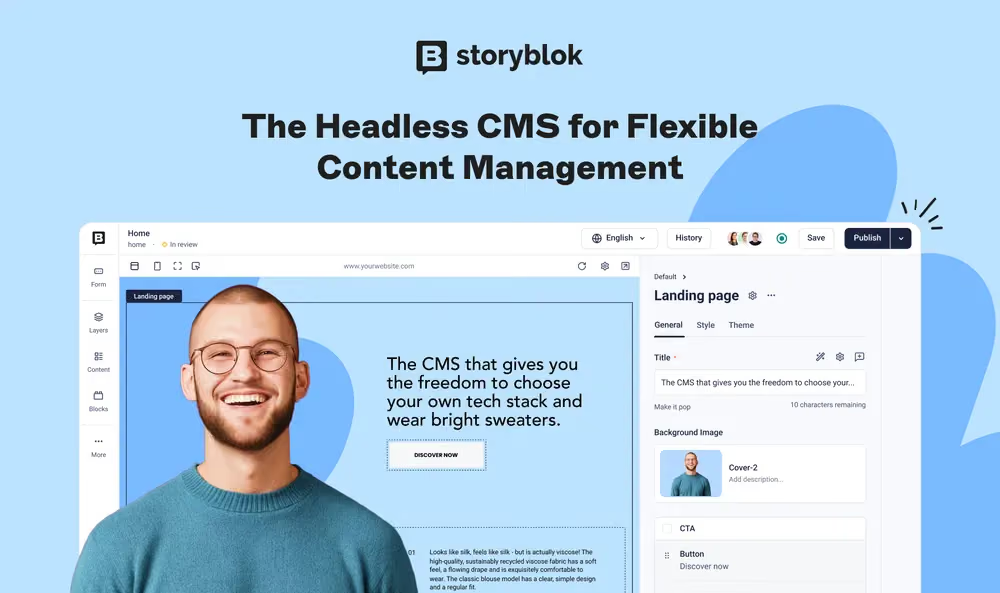
Storyblok is a hosted headless CMS built around a visual editor: marketers drag components onto a live preview of the page while developers fetch the same content as JSON from any frontend. That split is why agencies pick it, and it is also why the bill grows with people, not with content.
Seats, traffic, locales and API requests are each metered, and each paid tier caps them differently.
This review turns those meters into a monthly bill for a small, a mid-sized and a multilingual team, then compares the result with Sanity, Prismic, Hygraph and the self-hosted Payload. For the wider field, see our best headless CMS ranking.
Toolradar data: Storyblok's entry paid plan sits at the median entry price among Headless CMS tools with a verified price, joint #6 of 11, and it is listed as an alternative to 19 tools, per Storyblok on Toolradar, November 2026.
Methodology: this review reads Storyblok's pricing page and its public plan fact sheet, plus each rival's own pricing page, all on November 9, 2026. Monthly totals for a given team are our arithmetic on those printed rates. It is a read of published terms, not a benchmark we ran.
What is Storyblok?
Storyblok is a component-based headless CMS. Developers define blocks (a hero, a pricing card, a testimonial) as schemas, editors assemble pages from those blocks in the Visual Editor, and the Content Delivery API serves the result as JSON to any frontend framework or static site generator.
Every plan, including the free one, gets the Visual Editor, the Management API, image optimization and internationalization.
Billing is per space. A space is one project, so an agency running five client sites buys five subscriptions, not one. Each space carries its own seats, traffic and locale limits, which is the first thing to model before comparing Storyblok with a per-seat CMS.
Around the core sit AI credits for translation and content generation, Storyblok Agents on paid plans, integrations such as Shopify on Growth and up, and FlowMotion, a separate workflow-automation product sold only through sales.
How Storyblok works
You sign up free, and every new space starts with a 45-day trial of Growth Plus with no credit card. When the trial ends, the space drops to Starter unless you pick a paid plan. That trial is generous, but it also means a team can build on limits it will not keep, so check your seat and locale count against the plan you will actually buy.
Growth is the plan built for add-ons. It includes 2 locales, and you buy more at $20 each a month, extra traffic in 250GB blocks at $75 up to 1TB, and extra API requests at $10 per million up to 5M.
Growth Plus sells no add-ons at all: you get its fixed allowances and stop there, seats included, so a growing team eventually hits a wall rather than a bigger bill.
The usage line in the fact sheet matters too. Storyblok's plan fact sheet lists a usage breach fee of up to $1,000 that applies when a self-service space exceeds its API and traffic limits two months in a row, so a traffic spike that lasts is a pricing event, not just an upgrade prompt.
Storyblok key features
Storyblok pricing
Storyblok's pricing page, checked on November 9, 2026, lists three self-serve plans and two custom ones. Paying annually gives one month free, which turns Growth into $1,089 a year and Growth Plus into $3,838.92 a year by our arithmetic on the printed annual monthly rates. Seat add-ons are the lever that decides the plan: Growth sells extra seats at $15 each, up to 10, and the add-on prices also appear in Storyblok's plan fact sheet.
Here is the cost model on monthly billing, all our arithmetic. A 5-person team inside the Growth allowances pays the base fee. A 10-person team pays $174. Add 3 locales and one 250GB traffic block and that team reaches $309; push it to 10 locales and it reaches $409, which is $60 more than Growth Plus with 15 seats and 1TB included. Once Growth add-ons pass $250 a month, Growth Plus is cheaper.
Rivals bill differently. Sanity Growth is $15 per seat a month, so 10 seats cost $150. Prismic Medium is $150 a month paid annually for 25 users. Hygraph Growth is $199 a month billed yearly or $299 billed monthly for 10 seats, and Payload is free to self-host.
| Plan | Price | Best for |
|---|---|---|
| Storyblok Starter | $0 | 1 seat (up to 2), 100GB traffic, 100k API requests, 2 locales, Visual Editor |
| Storyblok Growth | $99/mo monthly, $90.75/mo billed annually | 5 seats (up to 10), 400GB traffic (up to 1TB), 1M API requests, add-ons available |
| Storyblok Growth Plus | $349/mo monthly, $319.91/mo billed annually | 15 seats, 1TB traffic, 4M API requests, 10 locales, no add-ons |
| Storyblok Premium and Elite | Contact sales | Environments, releases, GraphQL, custom roles, SSO, SCIM and higher uptime SLAs |
| Sanity Growth | $15 per seat/mo | Up to 50 seats, 25k documents, 100GB bandwidth, pay-as-you-go overages |
| Prismic Medium | $150/mo paid annually | 25 users, 5M API calls, 500GB CDN bandwidth, 5 locales, user roles |
| Hygraph Growth | $199/mo billed yearly, $299/mo monthly | 10 seats, 3 locales, 1M API calls, 500GB asset traffic |
| Payload self-hosted | $0 | Open source under the MIT license, runs on your own Node.js host and database |
Storyblok pros and cons
What we like
- The Visual Editor is on every plan, including the free Starter.
- Every new space gets a 45-day Growth Plus trial with no credit card.
- Growth Plus bundles 15 seats, 1TB of traffic and 10 locales at one fixed price.
What could be better
- Billing is per space, so each extra project is another subscription.
- GraphQL, environments and SSO are listed only on custom Premium and Elite plans.
- Two months over the API and traffic limits can trigger a breach fee of up to $1,000.
Who Storyblok is for
Storyblok fits a marketing team that wants to build and rearrange pages without filing a ticket, paired with developers who are happy to define components once. Agencies like it for the same reason: the Visual Editor is what clients see in the demo. A team of up to 5 editors in one language stays on the Growth base fee, which is a fair price for that editing experience.
It is a weaker fit in three cases. Teams with many editors but modest traffic pay less on a per-seat plan such as Sanity, whose free plan already allows 20 seats; our Sanity pricing breakdown runs those numbers. Developer-led teams that want the CMS inside their own Next.js app and database should price Payload, which costs nothing to self-host. And teams that need GraphQL, staging environments or SSO face a sales call on Storyblok, while Prismic includes GraphQL on every plan.
Whatever you pick, the frontend still needs a host: our best hosting for Next.js, Vercel review and Netlify review cover the deploy side, and best static site generators covers the build side.
Best Storyblok alternatives
If Storyblok is not the right fit, these are the closest options.
| Tool | Best for | Starts at | |
|---|---|---|---|
| Storyblok | Marketing-led teams that want a visual page builder on top of a headless API. | Free plan · Entry $99/mo · custom-priced plans too | Visit → |
| Sanity | Teams with many editors that want structured content and per-seat billing. | Free plan · Growth $15/mo per seat · custom-priced plans too | Visit → |
| Prismic | Website teams that want a page builder with cheap entry tiers and GraphQL included. | Free plan · Starter $10/mo on the annual plan · Small $25/mo on the an | Visit → |
| Hygraph | Teams building GraphQL-first apps that pull content from several remote sources. | Free plan · Growth $199/mo on the annual plan · custom-priced plans to | Visit → |
| Payload | Developer teams that want the CMS inside their own Next.js app and database. | Free and open source to self-host | Visit → |


The bottom line
Storyblok is worth it on Growth for a marketing-led site with up to 5 editors in one or two languages, where the Visual Editor saves developer time on every page change. Model the add-ons before you grow: once extra seats, locales and traffic cost close to the gap between the two plans, Growth Plus is the better buy, and past its seat cap or for SSO you are negotiating Premium.
Choose Sanity for many editors on per-seat billing, Prismic for a cheap page builder with GraphQL, Hygraph for federated GraphQL content and Payload when you would rather host the CMS yourself. Our best free static hosting and best dev tools for startups guides cover the rest of a lean stack.
Prices were checked on November 9, 2026 on the Storyblok, Sanity, Prismic, Hygraph and Payload pages; team totals are our arithmetic. Devshot sends developers the week's tooling price changes, so subscribe free to catch the next one.
Cite this: Devshot, "Storyblok Review 2026: Pricing, Pros, Cons and Alternatives", November 2026.
Frequently asked questions
Is Storyblok worth it in 2026?
How much does Storyblok cost?
Is there a free Storyblok plan?
Storyblok Growth vs Growth Plus: which should I pick?
Does Storyblok support GraphQL?
Some offers on this page may be paid placements or contain affiliate links.
Get the Devshot brief
Free daily newsletter, read in 5 minutes.
Subscribe free