
Mixpanel Review 2026: Pricing, Pros, Cons and Alternatives
What Mixpanel's event-based Growth plan costs from 1M to 20M events a month, what the free plan really covers, the billing traps developers hit, and how it compares with PostHog, Amplitude, Heap and Pendo.

Mixpanel is worth it in 2026 for product teams that want fast funnels and retention reports on a predictable event bill, and it stays free up to 1M events a month. Past that, the Growth plan is priced by event volume: 10M events a month cost $840 a month billed yearly or $1,176 billed monthly, on Mixpanel's own price breakdown. Every plan has unlimited seats.
The catch is the bill's shape: there is no billing limit, overages are charged on the next invoice, and above 20M events you need a sales quote. From 2M to 20M events, each extra million costs roughly $73 to $90 a month on yearly billing, our arithmetic on the published ladder. Closest alternatives: PostHog, Amplitude, Heap and Pendo.
Key factsBest for: Product teams that want polished funnels and retention…
- Event-based product analytics with replay, flags and experiments bundled, free to 1M events a month.
- Free plan: Up to 1M events a month with unlimited seats
- Self-serve ceiling: Growth goes up to 20M events a month; above that, pricing is custom
- Billing cap: No billing limit; overages are charged on the next invoice
- Yearly discount: About 29% off the monthly price at every volume, by our arithmetic
Pros
- 1M events a month free on Free and Growth, with unlimited seats.
- SAML SSO and SCIM on Growth, not only Enterprise.
- Full price ladder from 1M to 20M events published on the pricing page.
Cons
- No billing limit; overages are charged on the next invoice.
- Session replays kept only 30 days below Enterprise.
- HIPAA BAA and custom data retention are Enterprise only.
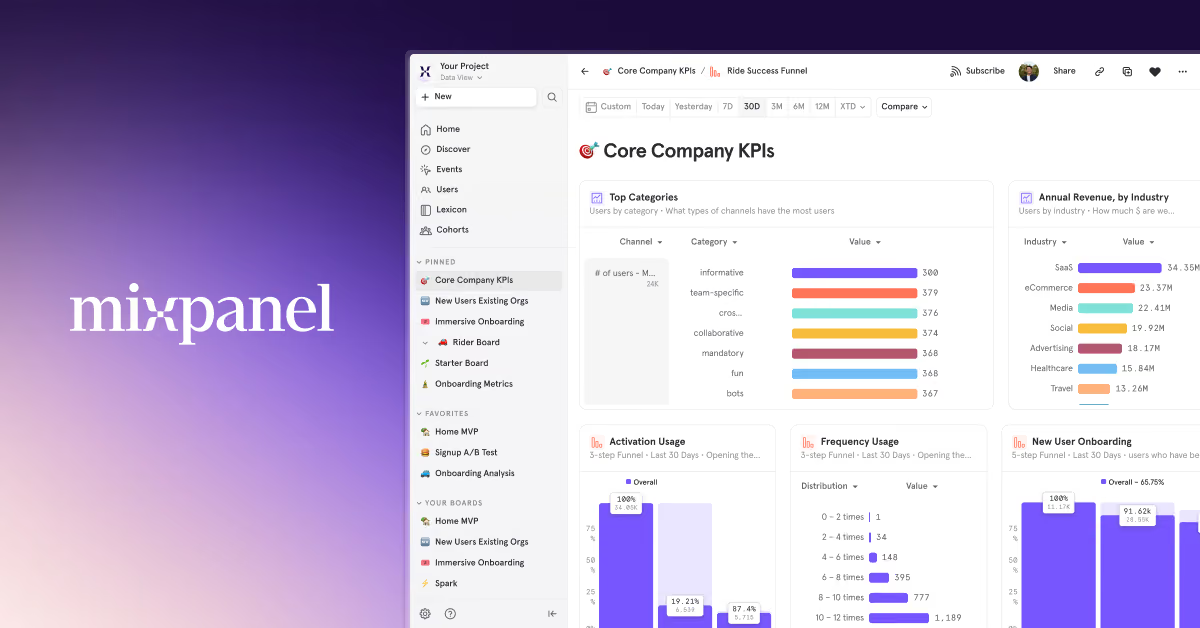
Mixpanel is the analytics tool engineers get asked to wire up when a product team wants funnels, retention curves and cohorts without writing SQL. You send events from your app, and the reports work on top of them.
The interesting question for a developer is not whether Mixpanel works, but what the event bill looks like once the app takes off.
This review is for developers and technical founders choosing a product analytics stack for a web or mobile app, from the first million events to roughly 20 million a month.
Prices and limits come from Mixpanel's pricing page and Mixpanel's pricing docs, both read on November 4, 2026. We run no test lab, so the verdicts rest on what Mixpanel publishes and on cost scenarios computed from its published price breakdown.
Toolradar data: Mixpanel is the 4th most-listed alternative among the 85 product analytics tools in the Toolradar catalog, the software directory we run, and it is listed as an alternative to 36 other tools as of November 2026.
The wider field is on Toolradar's product analytics ranking.
What is Mixpanel?
Mixpanel is an event-based product analytics platform for web and mobile apps. Its core reports are insights, funnels, retention and flows, and every plan now bundles session replay, heatmaps, experiments and feature flags alongside them. Mixpanel says it is trusted by more than 29,000 companies.
There are three plans. Free covers up to 1M events a month, 10K session replays, 10 active feature flags and 5 saved reports per seat. Growth starts at $0, includes the first 1M events, and scales by volume up to 20M events a month, with unlimited saved reports, SAML SSO and SCIM provisioning, custom properties and up to 50 feature flags.
Enterprise goes up to 1T events and adds data standards, anomaly detection, custom retention, HIPAA tools including BAAs, and a dedicated success team.
For developers, the newer pieces matter as much as the reports. Mixpanel lists an MCP server and an AI agent on every plan, plus Mixpanel Headless for working with the product as code. That makes it easier to query analytics from an AI coding tool, but it does not change the bill, which is still driven by events.
How Mixpanel works
You instrument the app with Mixpanel's SDKs or send events from your backend, and each tracked action counts as one event. Mixpanel bills on the total across all projects in the organization.
Identity calls such as identify, create alias and merge, plus opt-in and session recording checkpoint events, are excluded from the count, so identity management does not inflate the bill.
Going over the allowance does not drop data. On Free, Mixpanel keeps collecting events past 1M but pauses querying until you upgrade, and the Growth plan then starts from the first of that month, so the whole month's volume counts.
On Growth, events above your plan are billed at your à la carte rate on the next invoice. Mixpanel's docs say there is no way to set a billing limit; the suggested workaround is an alert report that warns you before you cross the line.
Retention is the other limit to plan around. Event data is kept for 2 years by default on every plan, and only Enterprise can set a custom retention policy. Session replays are kept 30 days on Free and Growth, so a team that reviews replays after a release cycle longer than a month will lose them. Downgrading to Free takes effect at the next billing date, not immediately.
Mixpanel key features
Mixpanel pricing
Mixpanel prints its full Growth ladder on Mixpanel's pricing page, read on November 4, 2026, from 1M to 20M events a month on both yearly and monthly billing; the table below lists the key steps. Above 20M events, both billing types move to custom pricing through sales.
Cost at 1M and 10M events, the two volumes most teams ask about. At 1M events a month the bill is zero on Free or Growth. At 10M events, Growth costs $10,080 a year on yearly billing or $14,112 a year on monthly billing, a $4,032 difference that Mixpanel prints itself.
On our arithmetic, yearly billing is about 29% cheaper than monthly at every step of the ladder.
The volume discount is thinner than the slider suggests. The first paid step is the steepest: going from 1M to 2M events moves the yearly price from zero to $185 a month.
After that, on our arithmetic, each extra million events adds between roughly $73 and $90 a month on yearly billing, so 20M events cost about $86 per million billable events against about $93 at 10M. Budget roughly linearly once you pass 2M events; the curve barely bends.
Whichever billing period you pick, Growth carries a trade-off developers should weigh: overages are billed at your à la carte rate, and there is no billing cap. A launch that triples traffic for a month shows up on the next invoice, not as a blocked dashboard.
Two programs change the math for some teams. Startups founded less than 5 years ago with up to $8M in funding get their first year free, with 1 billion events and 1 million session replays. And Mixpanel's docs still describe an MTU-based Enterprise plan that starts at $20,000 a year and is sold only through sales.
Against the field, PostHog's pricing page also gives 1M events free each month, then charges from $0.00005 per anonymous event and $0.000198 per identified event, with rates that fall as volume grows.
Amplitude's pricing page gives 2M events a month free and scales its Plus plan with volume, and Heap's pricing page prices by sessions, free up to 10K a month, while Pendo's pricing page quotes every plan on monthly active users.
| Plan | Price | Best for |
|---|---|---|
| Mixpanel Free | $0 | Up to 1M events a month, 10K replays, 10 flags, 5 saved reports per seat |
| Mixpanel Growth, 1.5M events | $100/mo yearly, $140 monthly | Unlimited saved reports, SAML SSO, 20K replays, 50 flags |
| Mixpanel Growth, 5M events | $438/mo yearly, $613 monthly | Same Growth features at a higher event allowance |
| Mixpanel Growth, 10M events | $840/mo yearly, $1,176 monthly | Same Growth features; $10,080 a year on yearly billing |
| Mixpanel Growth, 20M events | $1,635/mo yearly, $2,289 monthly | Top of the self-serve ladder; above this, pricing is custom |
| Mixpanel Enterprise | Contact sales | Up to 1T events, HIPAA tools with BAAs, custom retention, dedicated success team |
| PostHog product analytics | From $0.00005/event | First 1M events free monthly; identified events at a higher rate; billing limits |
| Amplitude Plus | Starts at $0 | First 2M events free; scales with volume up to 70M events; 2-year retention |
| Heap Growth | Estimate after install | Estimate shown after installing the snippet; unlimited users, 12 months of history |
| Pendo Base | Contact sales | Product analytics and in-app guides on a custom monthly active user volume |
Mixpanel pros and cons
What we like
- 1M events a month free on Free and Growth, with unlimited seats.
- SAML SSO and SCIM on Growth, not only Enterprise.
- Full price ladder from 1M to 20M events published on the pricing page.
What could be better
- No billing limit; overages are charged on the next invoice.
- Session replays kept only 30 days below Enterprise.
- HIPAA BAA and custom data retention are Enterprise only.
Who Mixpanel is for
Mixpanel fits product and engineering teams at apps with mostly signed-in users, roughly 1M to 20M events a month, that want polished funnels and retention reports and a fixed price per volume step. SaaS products, consumer apps with accounts and B2B tools all fit, and unlimited seats mean the whole team can use it without seat math.
The free tier is a real option for side projects and early products. A million events a month covers a lot of early traffic, and if you qualify for the startup program, the first paid year costs nothing. Teams that need SSO for a security review get it on Growth instead of an enterprise contract.
It is a weaker fit in three cases. A team that wants product analytics, error tracking and feature flags from one open-source vendor with hard spending caps should read our PostHog review, and PostHog vs Mixpanel runs the two bills side by side at several volumes.
A team that needs a HIPAA BAA must go to Mixpanel's Enterprise sales team. And an app far above 20M events a month cannot buy Mixpanel online at all.
For more options, see PostHog alternatives, PostHog pricing, feature flag platforms and dev tools for startups.
Best Mixpanel alternatives
If Mixpanel is not the right fit, these are the closest options.
| Tool | Best for | Starts at | |
|---|---|---|---|
| Mixpanel | Product teams that want polished funnels and retention reports on a fixed price per volume step. | Free plan · Growth $140/mo · custom-priced plans too | Visit → |
| PostHog | Developers who want analytics, replay, flags and error tracking from one open-source vendor with spend caps. | 1M events/mo free | Visit → |
| Amplitude | Teams that want a larger free event allowance and plan to grow into an enterprise analytics suite. | Free to 2M events/mo | Visit → |
| Heap | Teams that want autocapture and session-based pricing instead of instrumenting every event. | Free to 10K sessions/mo | Visit → |
| Pendo | Product teams that want analytics and in-app guides for onboarding in one tool. | Base, Core and Ultimate priced on custom monthly active user volume | Visit → |


The bottom line
Mixpanel is a strong pick for product analytics in 2026 if your app has mostly signed-in users and stays under 20M events a month. The free tier is generous, the Growth ladder is published in full, and SSO on Growth saves a trip to sales.
Budget for the bill to grow almost in a straight line after 2M events, and set up a usage alert, because nothing stops an overage.
Pick something else when control of spend or scale tips the balance. PostHog lets you cap the bill and bundles more developer tools, Amplitude gives twice the free events and self-serve volume past 20M, Heap prices by sessions for autocapture-heavy setups, and Pendo pairs analytics with in-app guides.
Teams adding monitoring next to analytics can compare our Sentry review and observability tools for startups.
Methodology: plan prices, the Growth ladder and plan limits were read on Mixpanel's pricing page and in Mixpanel's pricing docs on November 4, 2026, along with the pricing pages of PostHog, Amplitude, Heap and Pendo.
Per-million figures and discount percentages are our arithmetic on Mixpanel's published prices. We run no test lab and give no star rating.
Sources: Mixpanel pricing, Mixpanel pricing docs, PostHog pricing, Amplitude pricing, Heap pricing, Pendo pricing, Mixpanel on Toolradar, PostHog on Toolradar, Amplitude on Toolradar, Heap on Toolradar.
Cite this: Devshot, "Mixpanel Review 2026: Pricing, Pros, Cons and Alternatives", November 2026.
Frequently asked questions
How much does Mixpanel cost in 2026?
Is Mixpanel free?
What does Mixpanel cost at 10M events a month?
Can I set a spending limit in Mixpanel?
Is Mixpanel better than PostHog?
What are the best Mixpanel alternatives?
Sources
Prices and plan details come from each vendor's own pricing page, re-checked by the Toolradar pricing tracker.
- PostHog pricingchecked Sep 2026
Some offers on this page may be paid placements or contain affiliate links.
Get the Devshot brief
Free daily newsletter, read in 5 minutes.
Subscribe free